Wednesday, July 7, 2021

#132 EARGO Hearing Aids

 http://dennyhatch.blogspot.com/2021/07/132-eargo-hearing-aids.html


#132 Blog Post — Wednesday, July 7, 2020

Posted by Denny Hatch

The Huge Digital Ad Agency Sticks
 Its Toe in Direct Marketing Waters


This email arrived three weeks ago.

• Celebrate Father's Day? I have never been a father.

• (Is this a guy thing—only for fathers? What about Mom? And single women?)

• I never heard of EARGO.

• My hearing is perfectly okay.

• Ain't no way in hell I would stick that nasty looking thing—with what appear to be bristles or wires—deep into my ears. Eeeek!

• The main headline—"$450 OFF"—instantly signals a product costing thousands of dollars.

• Because the headline was all about price, I surfed Google and discovered EARGO hearing aids cost from $1700 to slightly less than $3000.

• Suddenly I'm forced to think about spending a lot of money. 

• $450 OFF could apply to anything—a motor scooter, kitchen appliances, a travel offer or a custom-made suit.

It's Immediately Obvious this Email Was Created By Marketers That Broke the Rules of Direct Marketing

For years Seattle's Bob Hacker—retired direct marketing agency genius, impresario, and curmudgeon—has railed against general agencies that claim to be experts in direct marketing.

It took a quick five minutes on Google to discover that name of the agency responsible for this brash, rule-breaking effort—HUGE.

I was right. Huge is not a direct marketing agency. Huge is not even a general agency.

It's a digital agency.

For a Taste of This Digital Agency
Check Out the Huge Landing Page

https://www.hugeinc.com
 

Learn more. Move the cursor over to the right and click on "Mat Baxter. CEO." I think you'll find it to be disjointed and making no sense.

(Incidentally in the six days of writing this blog post, the Huge landing page was changed 3x.) 

Now Scroll Down the Landing Page

• With the huge, overpowering headline featuring Mat Baxter, I was eager to find out who he is and his experience.

•  Alas, this is the only reference to—and photo of—Max Baxter on the landing page. I had to scramble all over the Huge website to find his bio.

• Prowl the website and you'll discover an agency that all about "we," "us' and "our." I couldn't find the words "you" or "your" anywhere.

• Huge is an agency filled with people hugely full of themselves.

              Am I Being Hugely Unfair to Huge?
Just to be sure I wasn't making a huge error I Googled the Huge staff directory to see if anybody—anybody at all—had direct marketing experience. I came up drier than the Mojave Desert in mid-summer.
     Lots of award-winning campaigns, Super Bowl spots, international travel, "digitally-led thinking," high-profile strategic engagements, newsworthiness, entrepreneurialism  and (my favorite) "helping clients capitalize on the seismic shift reshaping the marketing landscape."
     Click on the staff directory and you won't find a single mention of direct marketing experience anywhere in the CVs of the 21 agency principals.

Amazingly Ergo Has Entrusted Huge to Create a Huge,
Obviously Pricy Multi-media Direct Marketing Campaign


Medium #1: email
We examined the email to me in the lede of this blog post.

Medium #2: Direct Mail
Several days later I received this six-panel self-mailer printed on card stock folded down to 6" x 9" postcard size.

Here's a sample of copy from this postcard effort:

LICENSED HEARING
PROFESSIONALS
No unnecessary doctor appointments.
Just give us a call!

VIRTUALLY INVISIBLE
So small and slick they're
hidden from view

PURE COMFORT
So sleek and smooth you'll
probably forget they're there

EXCEPTIONAL AUDIO
State-of-the-art technology for
The highest sound quality

RECHARGABLE
No batteries required:
1 charge = up to 16 hours
of hearing perfection

LIFETIME SUPPORT
Access to licensed hearing
professionals
every step of the way, forever

Medium #3: Digital Ads—Lots of Them!
Below is one of the EARGO ads that showed up on my iPad, iPhone and seemingly everywhere I wandered surfing the internet. This one was in the middle of my morning
Apple News.


Medium #4: TV and Internet—
Check Out EARGO's Condom [sic] Spot.
You read that right: Condom Spot. It might win a creativity prize, but thoroughly embarrassing—and shaming—a nice American family (as well as giving TV viewers the creepy-crawlies) will not sell hearing aids.

https://www.youtube.com/watch?v=xwSqSITCLCk


                                            Takeaways to Consider
• Stan Rapp, legendary co-founder of the Rapp Collins Agency came up with the ultimate two-word definition of direct marketing: "Intimate Advertising."
 
• "Intimate Advertising" is not a brash, ballsy overpowering promise to deaf seniors to save $450.

• For starters, anybody who can afford $1700-$3000 for a hearing aid system would be far more interested in improved hearing—not saving $450.

• "Intimate" is generally a letter—in print or digital—from one writer whispering into the ear of one reader about recapturing the joyous sounds of music, theater, summer rain on the roof, waterfalls and—as E.B. White suggested—"the most beautiful sound in America, 'the tinkle of ice at twilight.' "

• "Lede with benefits. End with proof." —Gary North

• Of all the formats used in direct marketing, none has more power to generate action than the intimate me-to-you communication of a personal letter.

• For example, the most successful advertisement in the history of the world is the 777-word letter by Martin Conroy that brought in $2 billion in subscription revenue to The Wall Street Journal over the 25+ years it was mailed. (Think about it—777 words bringing in $2 billion. Why that's $25.7 million a word!)
http://dennyhatch.blogspot.com/2019/01/37-most-successful-advertisement-in.html

• Let's say you have been assigned the task of marketing a new product (or service). Where to start?

1. Learn everything about the features and benefits of the product.

2. Get inside the head and under the skin of the person you want to reach with your message. Think how he thinks, feel what she feels. Become that person.

3. Come up with a Unique Selling Proposition (USP)—a few pithy words that instantly capture the irresistible benefits of the product—and how it stands out from the competition.
http://dennyhatch.blogspot.com/2018/10/26-your-toughest-copywriting-challenge.html

4. Here's one for EARGO: "I can't believe it! I can hear everything for the first time in years!"

• The Huge agency writers and designers do not cause the hearts of hearing impaired seniors go pitty-pat with the benefits of hearing. Throughout their material they are fixated with the "features" of the product and show it over and over. The idea of sticking this grotesque thing deep into my ear gives me the willies. 

 • This is akin to Otto Von Bismarck's line about being served sausage right after seeing the inside of a sausage factory.

• A line of copy that gives me pause:
"No unnecessary doctor appointments. Just give us a call!"

• Why do the EARGO folks crap on doctors, calling them "unnecessary?"

• It seems to me the enthusiastic support, partnership and prescriptions of doctors would be a huge benefit to customers... and to EARGO.

• Put another way, if EARGO seems to be doing an end run around the medical profession, something must be wrong with the product.

###

Word count: 1069

Thursday, June 17, 2021

#131 Kantar Excellence Awards

http://dennyhatch.blogspot.com/2021/06/131-kantar-excellence-awards.html

#131 Blog Post — Thursday, June17, 2017

Posted by Denny Hatch


A Scheme to Give Awards to the Worst
TV, Internet & Digital Commercials of 2020

    The World's Most Creative and Effective Ads
"Great advertising needs to drive short term sales and build your brand in the long term. We analysed over 10,000 ads we tested in 2020 to identify the best ads.
     "Kantar's Creative Effectiveness Awards are the only advertising awards judged by consumers. They celebrate winning ads that are both creative and effective: advertising that is distinctive and helps drive sales in the short term and creates meaningful impressions to build brands in the long term."
—Kanter Intro


Below Are the 20 Winning Kantar
"Creative Effectiveness Awards 2021"


 https://www.youtube.com/watch?v=dD6r53DWxwk


 https://www.youtube.com/watch?v=nemoQhysUH8


https://www.youtube.com/watch?v=vAFL7J2WPAc


https://www.youtube.com/watch?v=vTdwHRf28zY


https://www.youtube.com/watch?v=PVwirX7Nom


https://www.youtube.com/watch?v=nAC2Q-FMMns


https://www.ispot.tv/ad/ZFut/google-find-your-scene-song-by-hall-and-oates


https://www.youtube.com/watch?v=y71F7wUyyPk


https://www.youtube.com/watch?v=0SqcViUYeZI


https://www.youtube.com/watch?v=9-eYXLMe_9E


https://www.youtube.com/watch?app=desktop&v=6pKyIY41Yjw&feature=youtu.be


UNAVAILABLE


https://www.youtube.com/watch?v=KChk_DDgzKg


https://www.youtube.com/watch?v=rXKB3aISYYY


https://www.youtube.com/watch?v=R2ju7lSc_RM


UNAVAILABLE


https://www.youtube.com/watch?v=A3730gNVAN0


https://www.youtube.com/watch?v=NGDWMTtBzgk


https://www.youtube.com/watch?v=2_mp960ayzs


https://www.youtube.com/watch?v=BxtxrNs7dFU


                            Takeaways to Consider
• I have 60 years' experience in direct marketing—a.k.a. accountable advertising and precise arithmetic. These ads are all manic and as unfocused as a giant Social Media cocktail party.


• All these ads are not judged on sales success. They were chosen by consumers who voted on their likeability.


• There is absolutely no way in hell to track the amount of product moved as a result of these ads. Not one of 'em can be judged on ROI.

• These are emphatically NOT "effective" ads.


• "Your job is to sell, not entertain."
   —Jack Maxson


• "I can't judge good marketing. It judges me. If can be shown to generate revenue and good ROI, it's good Advertising." —DH


• "Every time we get creative, we lose money."
   —Ed McCabe, President, RCA Record Club


A personal aside.  As editor and publisher of the WHO'S MAILING WHAT! newsletter and archive service, I was invited to be a judge of the Direct Marketing Association's ECHO Awards. This was heady stuff for me—a little industry squirt hobnobbing with the world's top agency executives and creative directors. We gathered at DMA headquarters in the Sour Apple to study and vote our choices for the best direct mail efforts of the year.
     I knew the most successful direct mail every year. My business was analyzing 1,800+ mailings a month and highlighting for my readers those that kept coming in over and over again—year after year. These repeats were the big winners—generating buckets of loot for the mailers (and for the copywriters if they were working on royalty basis).
     My great friend and mentor, guru Axel Andersson—was an equally avid student of direct mail as I. One day he called me from Florida with an amazing discovery. He had analyzed the prior year's ECHO winners and discovered only two percent of them were ever mailed a second time. That meant 98% of all the ECHO winners were failures—simply flash and filigree. It turned out ECHO was a sad-sack scheme among industry creatives to give each other awards for the trophy cases in their corporate waiting rooms. The object: to impress gullible prospective clients.
     I resigned from the committee. I was a nitwit to have become involved.


• "Awards are like hemorrhoids. Sooner or later every old asshole gets one."
   —Charlotte Rampling, "The Swimming Pool," 2003.


                        Now What?
First off, I urge you to sign up for Kantar's fat, fascinating PDF report on the 2021 Awards. It's free. No cost. No obligation.
https://www.kantar.com/campaigns/creative-effective


What do you think about these ads and this business model? I believe readers of this cranky blog would love to have your take on the program—and awards in general.

I invite you to share your thoughts. Am I nuts—an ancient curmudgeon who believes advertising should make money? Do take a moment. Scroll down to the Comment Section below and have at me!


If you find getting into the Comment Section too onerous, send me your thoughts and I will enter them for you. I am: dennyhatch@yahoo.com.

Thank you.

Cheers.


###

Word count: 639


Wednesday, June 9, 2021

#130 Car Insurance TV Idiocy

 
#130 Blog Post — Wednesday, June 9, 2021


 Posted by Denny Hatch
 

Absurd Automobile Insurance TV Ads:
Spewing Silly, Smarty-pants Gibberish


Continually, I am dumbfounded by the daily and nightly TV assault of cutesy-poo, smart-ass buffoonery in a feeble attempt to focus on the very serious business of auto insurance.


A Sampling of the Craziness
We All Must Endure on TV

Liberty Mutual: "Get your wet teddy bears! One hundred percent guaranteed."
https://www.youtube.com/watch?v=44YYT0mmjSo


Liberty Mutual: "LIMU EMU!"
https://www.youtube.com/watch?v=vgEJyRk45vo


Nationwide: "What did I just get into?"
https://www.youtube.com/watch?v=pAcRwxWmSX4


State Farm: "Hey, Drake. Stand-ins don't have lines."
https://www.youtube.com/watch?v=lvpq2OjmJvg&list=PLZdmq0GV_dGD6pLlUE8ZMJcuf89i1yY_q


Progressive: "Shouldn't something, y'know wacky, be happening right now?
https://www.youtube.com/watch?v=h5H_a2nYOxs


Geico: "I'm a gecko. Not Geico. So stop calling me!"
https://www.youtube.com/watch?v=DkxjzWLjFLE


Allstate: "C'mon. I saw you eating poop earlier."
https://www.youtube.com/watch?v=ZhXzBsHAEPk


Why Buy Auto Insurance?
Three reasons—and three reasons only:
1. It's the law.
2. If your car is damaged, you want it fixed.
3. If you get sued, you want to come out whole.


The Obvious Message to Drivers and Car Owners
It was Rosser Reeves (1910-1984), senior copywriter for Ted Bates & Co. In 1961 Rosser wrote "Reality in Advertising." It details the basic six points for successful ads and his famous USP concept—Unique Selling Proposition.


1. The USP is the one reason 'why' the product is needed to be bought or was better than is competitors. (Not one of the above wackadoodle TV commercials mentions this.)

2.  Rosser says, 'The proposition must be one that the competition either cannot, or does not, offer.' (Not one of the above wackadoodle TV commercials mentions this.)


3. It must be unique—either a uniqueness of the brand or a claim not otherwise made in that particular field of advertising. (Not one of the above wackadoodle TV commercials mentions this.)


4. The proposition simply states, 'Buy this product and you will get this specific benefit.'  (Not one of the above wackadoodle TV commercials mentions this.)


 5. The proposition must be so strong that it can move the mass millions. (Not one of the above wackadoodle TV commercials mentions this.) 


6. Reeves believes that the consumer tends to remember just one thing from advertising—one strong claim, or one strong comment. (Not one of the above wackadoodle TV commercials mentions this.)
—Posted by May-Ann,
http://cskills.blogspot.com


 Amazingly, one of the 16 greatest USPs—Unique Selling Propositions—is owned by Allstate:
     "You're in good hands with Allstate."
    
—David W. Ellis, General Sales Manager, 1950 


Alas, in the Allstate commercial—where Tiny Fey accuses her companion of eating poop—flashes the world famous "good hands" USP for 1/4th of a second at the very end.

              A Fascinating Aside is the huge heaps of
        money spent in 2019 on these appalling ads:

     Geico                  $1.618 billion

     Progressive.        $1.067 billion

     State Farm          $  802 million

     Allstate               $  437 million

     Liberty Mutual.    $  435 million

     USAA                  $  264 million


                USAA: A Serious Player in Insurance
USAA—United Services Automobile Associations—has positioned itself as the all-purpose insurer and friend of active, former and retired members of the American military establishment.


I was drafted into the U.S. Army for two years' service in 1958-1960. The country was at piece between two wars—Korea and Vietnam. I came away with a deep love and reverence for the American military. I reported for duty as a yardbird/buck private in a polo shirt, khaki pants and sneakers. Five days later we were summoned to the quartermaster warehouse and outfitted from top to bottom, inside and out, summer and winter uniforms, two pair each of dress shoes and combat boots. Never in my life—before or since—have I received so much stuff in the course of two hours. I was dazzled!

From the start I was mentored—told what to do, shown how to do it and came away with a lot of skills and knowhow that were useful throughout my entire career. Working in the Army Public Information Office, I was taught how to write press releases and wrote a ton of them. I was assigned to write, direct and narrate a documentary film on a National Guard training camp. I programmed and wrote the script for a radio series of recordings by the Seventh Army Symphony Orchestra in Germany that ran on WQXR in New York. Oh, yeah, did my share of KP and oversaw prisoners from the brig doing their menial jobs. And, of course, marched in a slew of parades (which I loved, especially when the band played Sousa). And served on the Armed Forces Day committee. For me the Army was a life changing experience.

Protecting the country is serious—life-and-death stuff—to our military branches. And protecting our military men and women during and after their service is equally serious business to USAA. That said, compare these two thoroughly professional, classic TV commercials to the fatuous crap above.

USAA Auto Insurance
https://www.ispot.tv/ad/Z7CD/usaa-made-for-martin
 

USAA Membership
https://www.ispot.tv/ad/tJoK/usaa-i-switched-free-tumbler


Takeaways to Consider

• "People do not buy from clowns." —David Ogilvy

• "Your job is to sell, not entertain." —Jack Maxson

• "Every time we get creative, we lose money."
—Ed McCabe, President, RCA Record Club

• "Learn the current rules so you'll know when you are violating them. All real breakthroughs have been made by people who went outside the so-called rules of their time. In retrospect, these breakthroughs seem logical—because they have now become the new rules."
—John J. Flieder


 • Three Rules for Braking the Rules
— Play by the rules until you have solid controls; you have a higher chance of success and less risk
— Break the rules after you have solid controls, because in breaking rules, the risk—and sometimes the cost—is much higher.
— There are two ways to find a breakthrough: Play the rules better than anybody else. Break the rules better than anybody else. —Bob Hacker


• Note: USAA is a membership organization. Circulation consultant Dick Benson said if you can turn a magazine into membership organization, you'll raise response 15%. Plus it's a reason to expand and offer members great deals on add-on goods and services. This may be testing in the insurance business à la USAA.


• Check out one of my favorite blog posts: Your Toughest Copywriting Challenge: the USP
http://dennyhatch.blogspot.com/2018/10/26-your-toughest-copywriting-challenge.html


###


Word Count: 1016

Wednesday, June 2, 2021

#129 Blog Post Ad Copy Challenge

http://dennyhatch.blogspot.com/2021/06/129-blog-post-ad-copy-challenge.html


#129 Blog Post - Wednesday, June 2, 2021


Posted by Denny Hatch
(with special thanks to Tia Dobi)


The Tia Dobi/Denny Hatch Challenge
To All Direct Marketing Copy Mavens


Above is an ad I wrote and designed to illustrate an early blog post three years ago. Here's the link:

http://dennyhatch.blogspot.com/2018/05/7-getting-your-prospects-to-say-yes.html


From Long-time Subscriber Tia Dobi to Denny Hatch
Hi Denny, I love your Harry's Razor and other mock ads. Has any company actually used your ad(s)? How would that work exactly... would you want monetary compensation or? I remember when Tom Collins wrote his Makeover Maven column for Direct. Then he bundled/wrote more and packed the first chunk of them into the book: "How I Would Have Done These Ads to Attract, Persuade, and Cultivate More Prospects." For 20 years I've wondered: Has any company ever snagged one of these gems? Thanks,
—Tia Dobi, The Word Alchemist.


DH to Tia Dobi
Hey Tia, Always great to hear from you. I vaguely remember doing the Harry's Razor ad, but am not sure where it was. No, nobody used it to my knowledge.

I well remember Tom Collins' Makeover column in Direct. It was terrific. Delighted you reminded me of it. Went looking for some of those columns on Google. Could not find them. The search was made impossible since his name, Tom Collins, is a splendid summer gin drink. Damn shame. Hate to lose all that thinking.

Tom's columns pissed off a legion of agency copywriters, designers, account execs and clients. His free ads were so much better than what the advertisers were paying big bucks for. A fascinating public shaming.

Do Keep in touch.


             The Tia Dobi/Denny Hatch Copy Challenge
You are invited to submit an ad—direct response or general advertising—for a product or service—an ad you passionately believe you could beat if you only had the chance. Send me the original ad plus your improved version plus your thinking in 100 words (or more). I will run both ads plus your commentary and open the blog post to readers' discussions and votes (1 to 5 stars).  


                        More Than One Entry?
Serious players deserve serious attention. Will give coverage to all comers. Welcome! 


Grand Prize
Copy #1 of Denny's Soon-to-be
Self-published Anthology
(It's currently being copy edited at
Archway/Simon & Schuster)


                    FOUND! DIRECT MARKETING GOLD!
It turns out Tia Dobi has a cache of actual tear sheets from DIRECT featuring the Tom Collins' Makeover Maven columns. Tia chose the gem that follows:


Barry Bonds Wouldn't Think
An Asterisk Makes Him Special

by
Thomas L. Collins, The Makeover Maven


I did a makeover of an IBM ad some four years ago in this space. That one featured an out-of-focus photo of a reindeer and a headline in white letters: "Finnair Sees It" (The Makeover Maven, Oct. 15, 2003). I guess the same creative team is still around. And I guess they didn't read my column and decide to mend their ways. So I guess I'll have to tackle them again.


Not that it matters, of course. IBM still has $90 billion in annual revenue and 350,000 employees around the world. So why do they bother to advertise at all? I will forgo my usual sarcastic speculations and leave that to wiser heads.


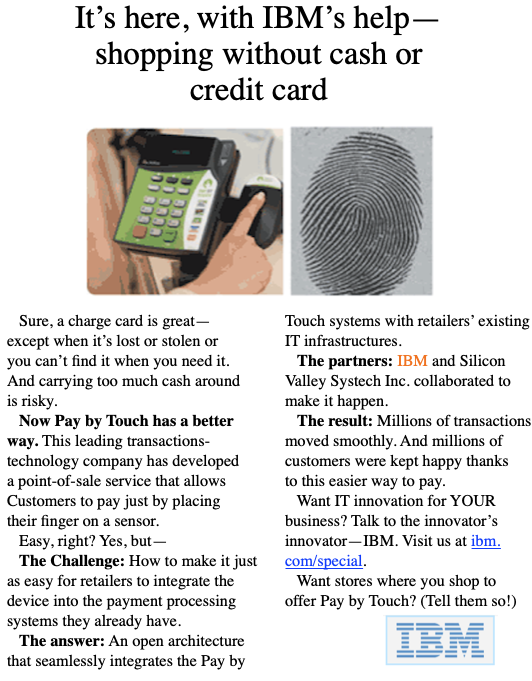
But it will take a pretty wise head to figure out the thinking, if any, behind this ad for the Pay by Touch technology they've helped develop. Part of the puzzle is that I stumbled on the ad in Working Mother magazine.


OK, so working mothers who shop frequently at the supermarket should enjoy the convenience of simply laying a finger on a sensor pad at the checkout counter instead of having to fumble around for a credit card or a fistful of cash. But do working mothers really want to take time out from their busy day to fight their way through copy about "open architecture that seamlessly integrates the Pay by Touch system with retailers' existing IT infrastructures"?

And when I say "fight their way" through the copy, I'm not kidding. Nobody in my household, including me, could decipher that text in extra-tiny white type on yellow without a magnifying glass, and even then it was tough. I don't mean to seem condescending to working mothers. A certain percentage of the magazine's readers may indeed be working moms who are employed at sophisticated IT jobs.

But how significant a number? In the ad we see a bleed photo of a woman shopping in a supermarket's frozen food aisle. Near her hand that's opening a freezer door is a giant asterisk. The asterisked footnote is a tiny headline in white type: "This finger is legal tender." Followed by that totally unreadable extra-tiny white text.

So nine-tenths or more of the bleed page is devoted to a striking photo of a shopper in a frozen food aisle. But the ad is not selling frozen foods or frozen food lockers. It's announcing the progress made in a revolutionary new way of paying for purchases. But the ad doesn't convey the excitement of important news.

When I was a copy chief I had some wonderful writers. But I was always on guard against a sloppy word or phrase which merely conveyed approximately what the writer intended.

In this case, "The finger is legal tender" is only approximately true. Sorry to be picky, but a homeless person with no assets would have a hard time trying to buy groceries with no legal tender other than his or her fingerprint.

My larger complaint about the ad, however, is that its purpose is not clear. You can't deliver a message if you don't know who it's intended for. So who is the ad primarily addressing? And what is the message it's trying to deliver?

I finally decided that it was designed to influence not one audience of readers but three, with three different messages. If you're a consumer, the aim is to make you and thousands of other readers want and demand Pay by Touch service at your favorite local retailers.

If you're a store owner or manager, it's to get you to start thinking about or giving more thought to installing Pay by Touch in your store. And if your office job demands wrestling with information technology challenges, it's good to be reminded that IBM is there to help you, just as they did with Pay by Touch. Even if poorly executed, the ad is a kind of IBM case history. And if it brings new business to IBM's client Pay by Touch, that's also good for IBM.

It could be argued that the original ad does deliver these three messages to these three audiences. But it does so indirectly and unreadably that the intended reader would not be inclined to stop right there and say, "This means me."


In my makeover, the headline and illustrations convey exciting news to both consumers and retailers, and at the same time fulfill the requirement of Point No. 7 from my Makeover Maven Measuring Stick: “Does the ad build brand recognition and trust?”

The illustrations I chose do what illustrations are supposed to do — illustrate. The pictures of a sensor pad and a fingerprint convey what the ad is talking about far better than a picture of a shopper laying her finger on a frozen-food locker's door handle.

Next I set about rescuing the original ad's text by displaying it in larger, infinitely more readable type — using boldface leadoffs to pull the eye through more easily — starting off with the classic problem/solution copy formulation and keeping in mind all three audiences along the way. So the reader who is only a consumer and who is bored by talk of “open architecture” can skim quickly through the ad and still come away wanting the convenience of Pay by Touch.

If you'd like to compare the original copy with my rewrite, here's what their unreadable fine print says:

Biometrics pays — literally. [Editor's note: To whom? for whom? No “you” in the copy.] Pay by Touch, a leading transactions technology company, [has? — Ed.] developed a point-of-sale service that allows customers to pay just by placing their fingers on a sensor. Easy, right? The challenge: to make it just as easy for retailers to integrate the device into the payment processing systems they've already got up and running. IBM and business partner Silicon Valley Systech Inc. collaborated to create an open architecture that seamlessly integrates the Pay by Touch system with retailers' existing IT infrastructures. Keeping millions of transactions moving smoothly. And as many customers happy. Want innovation for integration? Talk to the innovator's innovator. Call on IBM. To learn more, visit ibm.com/special.


"What makes you special?"


I certainly omitted that puzzling last line. To me it seemed almost sarcastic, as in, "What makes you so special, wise guy?"


And I didn't make any special effort to steer business prospects to IBM's Web site because I found it so disappointing. But that's not my department.


THOMAS L. COLLINS (1919-2013) was a direct marketing copywriter, ad maker, agency creative director and co-author of four books on marketing including the legendary MaxiMarketing with his longtime partner Stan Rapp, co-founder of the agency Rapp & Collins.


###

Word count: 1522